The older men’s experiment
Sermorelin research: IGF-1 rose. Then what?
The strongest adult result here is a change in blood. The details are more interesting than the slogan built from it.
The Sermorelin studies behind the IGF-1 claim
Corpas and colleagues’ experiment compared 10 healthy older men with 9 young men. The older men’s mean age was 68. Researchers gave GHRH(1-29) subcutaneously at 0.5 mg and 1 mg twice daily for 14 days, measuring 24-hour growth hormone and IGF-1.
The increases were dose-related. After the higher study amount, the measured growth hormone and IGF-1 parameters no longer differed from those in the young men. Fasting glucose did not change. So, does sermorelin increase IGF-1? In these older men, under these study conditions, yes.
I read the comparison with younger men as a demonstration of endocrine responsiveness. Calling it a reversal of aging changes the outcome without changing the experiment. There was no demonstrated gain in longevity, strength or everyday function in this result.
That is the useful starting point for sermorelin growth hormone therapy research: a real response, a small group and a brief observation window. The amounts page puts the protocol beside the pediatric and pharmacokinetic studies rather than turning it into a treatment plan.
Sermorelin, the liver and the feedback that remains
The liver enters the story downstream. Sermorelin acts at the pituitary GHRH receptor; the resulting growth hormone stimulates hepatic IGF-1 production. The review of GHRH biology covers this signaling, and the review of central and peripheral regulation places it within the larger hormone system. “Hepatic” simply means relating to the liver; it does not make this a trial of liver health.
Sermorelin’s mechanism of action includes signaling through cAMP and PKA inside the growth-hormone-producing cells. Somatostatin and IGF-1 help restrain release. The human study of growth hormone’s own feedback found that free fatty acids and somatostatin were involved in limiting the response.
A working brake does not settle the question of a beneficial destination. Feedback makes that tidy explanation less convincing to me. In 17 healthy young and older men, experimentally supplied IGF-1 inhibited the GHRH response less in the older men, and suppression of fasting growth hormone was also blunted. Feedback still needed investigation before it could offer any guarantee.
The drug’s clock and the gland’s clock
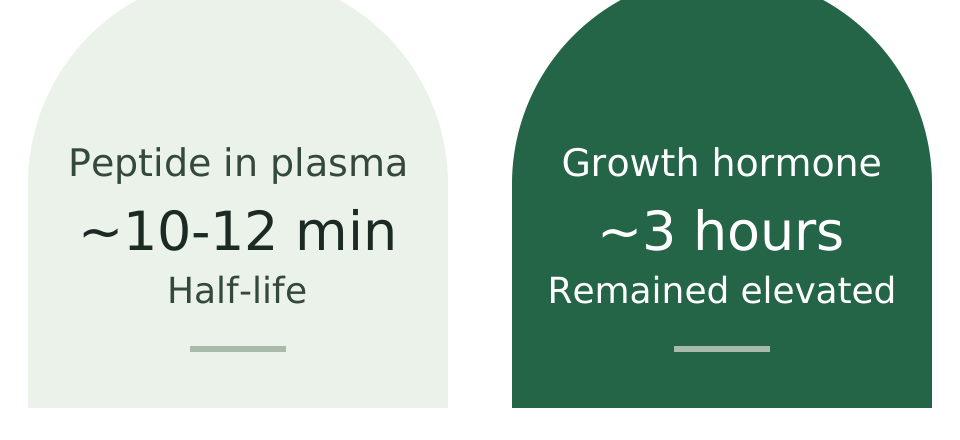
In Wilton’s pharmacokinetic study of 30 healthy men, intravenous GHRH(1-29) had a plasma half-life of about 10-12 minutes, while growth hormone stayed elevated for about 3 hours. Half-life describes how quickly the drug’s concentration falls by half. The duration of the gland’s response is a separate measurement.
Those mismatched clocks are the part of the pharmacokinetics I enjoy: a brief signal can leave a longer hormonal response. But neither clock measures how long a person feels better. Intranasal bioavailability was only 3-5%, another reminder that the route mattered to what reached the blood.
A separate antagonist study of aging men worked in the opposite direction, blocking GHRH receptors to investigate the fall in growth hormone. Nocturnal growth hormone was about 30% lower in older men, and the inhibition pattern suggested lower endogenous GHRH output. This investigation addressed why secretion changes with age; whether restoring it improves health remained unproved.
Testosterone wasn’t the result being raised
The association between sermorelin and testosterone can blur the question being asked. In the GHRH and GHRP-2 synergy experiment, 47 men aged 18-74 were studied under a sex-steroid clamp: medication held sex-hormone conditions steady while researchers tested growth hormone release.
Visceral fat, IGF-1 and IGFBP-3 together explained 60% of the variability in the combined response. Visceral fat was negatively associated with the response and IGF-1 positively associated. That percentage describes variation in hormone secretion rather than a success rate.
I won’t turn a study that controlled sex steroids into evidence that sermorelin raises testosterone. Nor does it establish a suitable combination with testosterone treatment. The comparison page examines the actual pair tested, GHRH and GHRP-2, before the result gets attributed to other drugs.
The cognition result belongs to tesamorelin
The controlled cognition trial is compelling enough to deserve its correct drug name. It tested the stabilized GHRH analog tesamorelin in 152 older adults, including 66 with mild cognitive impairment, over 20 weeks. Participants received 1 mg/day subcutaneously before bedtime or placebo in a randomized, double-blind design.
Cognition showed a favorable effect (P=0.03), IGF-1 increased by 117% within the physiological range, and percent body fat fell by 7.4%. Adverse events were mild. I admire the attempt to measure something beyond a hormone concentration. I object when the result becomes a sermorelin memory claim with the name of the tested drug quietly removed.
For the same reason, the stronger body-composition findings with tesamorelin do not establish sermorelin weight loss in healthy adults. The older men’s sermorelin experiment did not demonstrate muscle growth or increased strength. These are attractive research questions, but they need outcomes of their own.
Sleep is a reason to investigate, not a timetable
Growth hormone is released in pulses during deep sleep, and GHRH can influence sleep. The cognition paper’s discussion of sleep and hormone physiology helps explain interest in nocturnal administration; the published research also reports that GHRH’s sleep effects depend on when it is given.
That makes timing part of the scientific question. It supplies no personal schedule for sermorelin, and it does not establish that the timing of tesamorelin in the cognition trial is best for another medicine. The sleep accounts sound much more varied than a bedtime rule would suggest.
The result I’d welcome next is an adult sermorelin trial that follows health and function alongside hormones for substantially longer. Until then, the IGF-1 finding is still interesting. It just has to remain an IGF-1 finding.